
How to Tell Time in Hindi: A Fun and Practical Guide


Have you ever found yourself completely lost when someone exclaims, “साढ़े तीन बजे मिलना!”? Or maybe you’ve been told “सवा आठ” with a cheery smile, and all you could do was nod and hope you’d figure it out?
Telling time in Hindi is a delightful little puzzle—full of charming “fractions” and rich context—unlike the straight “half past” or “quarter to” of English. Welcome to a world where understanding पौने चार, सवा दो, डेढ़, ढाई, साढ़े, and even सुबह तड़के, दोपहर, गोधूलि, पूर्वाह्न (AM), and अपराह्न (PM) can truly make you feel like a local.
If you are new to learning Hindi then telling time may sound confusing in the beginning. Don’t worry! By the time you finish reading this, you’ll be a Hindi Time Master, capable of decoding any time-telling phrase that comes your way. Grab a chai, relax, and let’s unravel the secrets of the Hindi clock together.
Meet Amrita: A True-Story Introduction
Imagine Amrita, a new intern from Kolkata who’s just arrived in Delhi. She’s eager, punctual, and determined to make a good impression. One weekend morning, a text from her colleague Gayatri pops up on her phone:
“पौने पाँच बजे कॉफी पीने चलते हैं!”
Amrita blinks in confusion.
“पौने पाँच?” She wonders.
“Should I come at five, or does it mean almost five?”
Suddenly, time in Hindi feels as mysterious as quantum physics. But don’t fret—let’s break it down step by step!
The Hindi Clock: It’s All About Fractions and Feeling
In Hindi, you don’t just say 5:15 or 8:45. There’s poetry and personality even in something as basic as time! These special time words color the day and make every meeting feel unique.
Let’s meet your new best friends:
सवा (sawa): The Quarter Past
Meaning: "A quarter past"—fifteen minutes after the hour.
- 1:15: सवा एक (sawa ek)
- 2:15: सवा दो (sawa do)
- 7:15: सवा सात (sawa saat)
When someone says, “सवा आठ बजे आ जाना,” you need to be there at 8:15—not 8, not 8:30!
पौना (pauna): The Quarter To
Meaning: "A quarter to"—fifteen minutes before the next hour.
- 4:45: पौने पाँच (paune paanch)
- 7:45: पौने आठ (paune aath)
- 12:45: पौने एक (paune ek) (yes, “one” is the *next* hour here!)
So, “पौने पाँच बजे” means 4:45. Think of it this way: अगर समय “पौने पाँच” है, तो अभी पाँच बजने में पन्द्रह मिनट शेष हैं।
साढ़े (saadhe): The Half Past
Meaning: "Half past"—thirty minutes after the hour.
- 1:30: साढ़े एक (saadhe ek)
- 2:30: साढ़े दो (saadhe do)
- 7:30: साढ़े सात (saadhe saat)
So if Dadi says, “साढ़े सात बजे खाना तैयार हो जाएगा!,” that’s 7:30 (and don’t be late!).
डेढ़ और ढाई: The Trickiest Times
Hindi has a special flair for halves, with unique words for 1:30 and 2:30:
- डेढ़ (Dedh): 1:30
- ढाई (Dhai): 2:30
So:
- 1:30: “डेढ़ बजे”
- 2:30: “ढाई बजे”
No English equivalent for these! “डेढ़” and “ढाई” are purely desi.
Basics: The Sharp Hours
- 1:00: एक बजे
- 2:00: दो बजे
- 12:00: बारह बजे (noon/midnight)
Sometimes, you’ll hear “ठीक” (theek) for “sharp,” as in “ठीक एक बजे”—exactly at one o’clock.
The Hindi Day: More Than Just Numbers
Now, let’s make your sense of time even richer by adding context words! When, exactly, are you supposed to show up? That’s where these beauties come in:
सुबह तड़के (Subah Tadke): Early Morning
This phrase means “at the crack of dawn”—anywhere between 4:00AM and 6:00AM.
Example:
“सुबह तड़के पाँच बजे उठना है।”
(I have to wake up at 5 in the early morning.)
सुबह (Subah): Morning
Think 6:00AM–11:00AM.
Example:
“सुबह आठ बजे मिलते हैं।”
(Let’s meet at 8 in the morning.)
दोपहर (Dopahar): Afternoon
Usually, this means 12:00PM–3:00PM.
Example:
“दोपहर एक बजे खाना खाते हैं।”
(We’ll eat lunch at 1PM.)
गोधूलि (Godhooli): Twilight/Dusk
This is the magical hour when cows return home and the world glows soft golden—sunset, roughly 6:00PM–7:00PM.
Example:
“गोधूलि के समय मन्दिर चलेंगे।”
(We’ll go to the temple at twilight.)
शाम (Shaam): Evening
After sunset, 7:00PM onwards.
Example:
“शाम सात बजे फ़ोन करना।”
(Call at 7 in the evening.)
AM/PM in Hindi
For clarity, especially in letters, schedules or official invitations, Hindi often uses:
पूर्वाह्न (Poorvahan): AM (before noon)
अपराह्न (Aparahan): PM (after noon)
So,
साढ़े छह बजे पूर्वाह्न = 6:30 AM
पौने सात बजे अपराह्न = 6:45 PM
But in conversation, people prefer:
सुबह साढ़े छह बजे (6:30 AM)
शाम पौने सात बजे (6:45 PM)
Conversation Time! Real-Life Dialogues
Let’s see how these phrases play out:
Example 1:
You: “क्या समय हुआ है?” (What time is it?)
Friend: “गोधूलि है, सवा छह बजे हैं।” (It’s twilight, it’s 6:15 AM)
Example 2:
Boss: “कल दोपहर पौने दो बजे बैठक है।” (Tomorrow, the meeting is at quarter to two in the afternoon—1:45PM.)
Example 3:
Relative: “सुबह तड़के चार बजे स्टेशन पहुँच जाना।” (Get to the station by 4 in the early morning)
Pro Tips: Sounding Like a Local
- Notice how people will often omit AM/PM—relying on the context words to clarify.
- “साढ़े पाँच बजे” at “सुबह तड़के”—no one will show up at 5:30PM!
- Older people love using “सुबह तड़के” and “गोधूलि”—it makes your speech poetic and relatable.
- If you’re texting, you can always add “पूर्वाह्न” or “अपराह्न” for formality.
 Reena Daruwalla
The Hindi Clock in Action: Let’s Practice!
You arrive at your friend’s house at “सवा आठ” (8:15) with the sun shining. You’re on time, which makes you a punctual guest!
Your Dadi is prepping her famous parathas. She warns, “साढ़े सात बजे खाना तैयार हो जाएगा!” But next morning comes “सुबह तड़के पाँच बजे उठ जाना।” No snooze button works—she means business!
If Dadi invites you for tea at “गोधूलि के समय पौने छह बजे”, she’s welcoming you at 5:45PM, right as evening light turns golden.
If your boss schedules a call at “अपराह्न चार बजे,” remember: that’s a formal 4PM appointment—not to be missed.
Or if you see “पूर्वाह्न सात बजे” on your train ticket—that’s 7AM sharp.
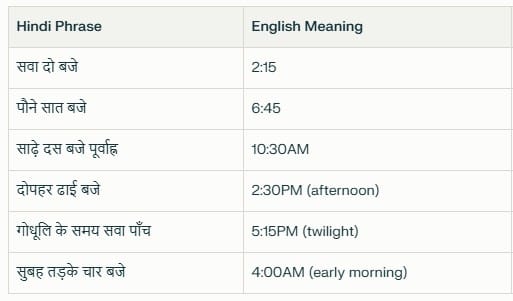
Quick Reference: Common Hindi Time Phrases
Wrapping Up – Your Hindi Clock Superpowers
By now, you know that Hindi time-telling is more than just numbers—it wraps in fractions, flavor, and context.
Whether you’re meeting friends at “सवा चार बजे दोपहर,” waking up at “सुबह तड़के पाँच बजे,” or soaking in the evening glow at “गोधूलि के समय पौने छह बजे,” you’ll never be confused by Hindi time phrases again.
So next time someone tells you, “कल दोपहर पौने दो बजे मिलना मत भूलना!” you’ll smile, check your watch, and say— “बिल्कुल! अब मैं समय नहीं भूलूँगा।”
Practice a little each day, chat with elders, and soon you’ll be reading the Hindi clock like a pro—and a local!
